
Checking a Listed Company's Numbers: 275 TH/s to 2.75 PH/s
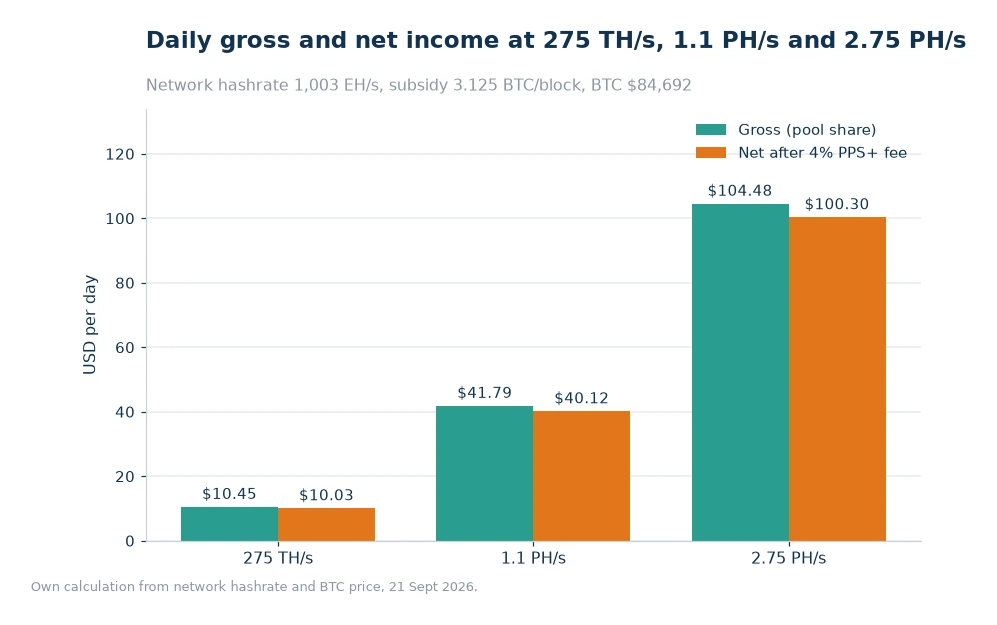
Every mining company on a directory has a hashrate to advertise and a price per terahash to defend, and the two are easy to state loosely. At 275 TH/s the daily credit is 0.00012337 BTC, about $10.45 gross and $10.03 net of the listed 4%. Multiply by ten and by a hundred and you have the two larger scales a seller might quote you.

Key takeaways
- 275 TH/s is 0.00012337 BTC a day, $10.45 gross and $10.03 net of the listed 4%.
- 1.1 PH/s is four times that, and 2.75 PH/s is ten times, so any quote should scale linearly before anything else is discussed.
- The price per terahash is the figure that hides fee assumptions, so ask for the all-in monthly cost at your own size.
- Two references from clients of similar size are worth more than any capacity claim on a listing.
What a listing can be checked against
A directory entry typically carries a name, a location, a description and a hashrate. Of those, only the hashrate is arithmetic, and that is where an audit starts. A claimed capacity can be compared against the income it should produce, and the income can be compared against the price being asked for it. If the two do not line up, either the capacity or the price is doing something the description does not explain.
Everything else in the entry is a claim about conduct: uptime, response time, repair policy, financial standing. Those cannot be checked from a web page. They can be checked from a contract, a site visit and two references, and the value of the directory is that it gives you a list of names to put through that process.
Three scales, three levels of claim
The table converts the three tiers into income and pairs each with the claim that most needs testing at that size. A small seller is usually claiming reliability; a large one is usually claiming a price advantage.
| Scale | Hashrate | Net per day | Net per 30 days | Claim to test |
|---|---|---|---|---|
| One rack | 275 TH/s | $10.03 | $300.90 | Uptime record |
| Four racks | 1.1 PH/s | $40.12 | $1,203.60 | Repair turnaround |
| Half container | 2.75 PH/s | $100.30 | $3,009.00 | All-in tariff |
The monthly net is the budget the seller is asking you to trust them with. At 2.75 PH/s that is $3,009 a month of gross output before power, and a two-point difference in the quoted tariff is worth more than the entire pool fee. Anyone negotiating at this size should be spending their attention there.
The price per terahash hides the assumptions
Quotes arrive as a number per terahash, sometimes per day and sometimes as a one-off purchase price. Neither is wrong, and both are incomplete without the tariff, the cooling charge, the minimum term and the repair policy. A quote that looks 15% cheaper per terahash can be 15% more expensive once a fixed monthly fee is added at your block size.
The fix is to convert every quote into one number: total monthly cost at your hashrate, including everything the invoice will contain. Ask each seller to state that figure in writing, alongside the hashrate it is based on. Three quotes expressed that way can be compared in a minute; three quotes per terahash cannot be compared at all.
Worked example: verifying a 2.75 PH/s claim
Take the largest tier and work backwards to a monthly figure.
- Daily issuance per terahash: 450 ÷ 1,003,000,000 = 0.00000044865 BTC.
- At 2,750 TH/s: 2,750 × 0.00000044865 = 0.00123379 BTC a day, carried as 0.00123367.
- Dollars: 0.00123367 × 84,692 = $104.48 gross.
- Net of the listed 4% on the block-reward part: 104.48 × 0.96 = $100.30.
- Thirty days: 100.30 × 30 = $3,009.
- At 20 J/TH the load is 55 kW, which is 1,320 kWh a day; at seven cents that is $92.40, leaving $7.90 a day of margin before any hosting fee.
- A hosting fee of $0.02 per kilowatt-hour would add $26.40 a day, turning the margin negative at this price.
That last pair of lines is the audit in miniature. A seller quoting a tariff that leaves no margin at current conditions is either counting on a price rise or planning to recover the difference somewhere the quote does not mention. Neither is automatically disqualifying, but both deserve a question.
Scaling should be boring
One useful test of a seller's numbers is whether they scale without drama. Four times the hashrate should be four times the income, and ten times should be ten times, up to the rounding in the published figures. When a quote for the larger block carries a better rate per terahash, ask what changed: a volume discount is normal, and so is a longer term, but the reason should be stated.
The tiers in this article were chosen for that reason. 275 TH/s to 1.1 PH/s is exactly four times, and to 2.75 PH/s exactly ten times, so any quote that does not land on those multiples has something in it beyond hashrate. Sometimes that something is a fixed fee, sometimes it is a bundled service, and sometimes it is an error. All three are worth finding before signature.
Two references and one site visit
Ask for two clients of similar size, not two of the largest. A 2.75 PH/s client will describe a different service from the one a 275 TH/s client receives, and the smaller reference is the one that tells you how the company behaves when the account is not its biggest. Ask each reference three things: how long a repair took, how often the published uptime matched what they saw, and what happened at the end of the term.
Then visit. A site visit is not an inspection of the machines; it is an inspection of the people. Whether the person showing you around knows the tariff without checking, whether the spares are on a shelf or on order, whether the monitoring screen is on a wall or in a drawer. Those observations are worth more than any figure in a listing.
Red flags that are not fraud
Not every awkward answer is a warning. A company that will not quote a price before a call is protecting a negotiation, which is normal. A company whose listed hashrate is out of date is often just slow at updating a directory entry. A company that declines a very small block is being honest about its economics rather than difficult.
The flags that matter are different in kind. A refusal to state the all-in monthly cost in writing. An uptime figure with no definition attached. A repair policy that changes between the call and the contract. Those are not stylistic; they are the parts of the relationship that decide who pays when something breaks. Miner Hosting is a service business before it is a technical one, and the paperwork reflects that.
The ViaBTC Mining Companies listing is the shortlist, and the Statistics page supplies the network context that every quote depends on. Neither is a substitute for the two references, and both make the references easier to question. The Miner Profitability Ranking is the third page worth opening, because a seller's machine list can be checked against what those models earn at today's difficulty.
Frequently asked questions
How do I check a company's claimed hashrate?
Compare the income it should produce with the price being asked. At 2.75 PH/s the gross is $104.48 a day and the net $100.30 at $84,692, so a quote that implies a much higher return is assuming a different price or a different fee.
What should a hosting quote include at 1.1 PH/s?
Space, power at a stated tariff, cooling, monitoring and a defined repair policy, all expressed as one monthly cost. Ask for that figure rather than a rate per terahash, because the fixed components are what make two quotes incomparable.
Is a cheaper tariff always better?
No. A tariff that leaves no margin at current conditions depends on a price rise to work. Test it against the net figure at your hashrate, and treat any quote that only works at a higher bitcoin price as a bet rather than a price.
Turn the claim into a sentence you can defend
Write one paragraph: this company will host this many terahashes, at this all-in monthly cost, with this repair policy, for this term, and here are two clients who confirm it. If the paragraph cannot be written after the calls and the visit, the answer is not yet, and waiting costs nothing but a week.
Sources: ViaBTC companies, statistics and miner ranking pages. Inputs sampled 21 Sept 2026: 1,003 EH/s network hashrate, 132.76 T difficulty, 3.125 BTC per block, BTC $84,692. Power arithmetic assumes 20 J/TH and the tariffs quoted in the text. Published 24 Oct 2026[1].